The question every leader is now being asked
What does it actually take to turn digital transformation into ROI? Every board agenda is circling some version of that question. Every technology budget is too. And the question has only sharpened as generative AI, automation, robotics, and predictive analytics have moved from experiment to expectation in less than three years. Here is the awkward part. The pressure to act has never been higher. The evidence that action is paying off has rarely been thinner.
Look at the numbers. MIT’s NANDA initiative published a study in 2025 called The GenAI Divide: State of AI in Business. Enterprises poured somewhere between 30 and 40 billion dollars into generative AI. And roughly 95 percent of the pilots delivered nothing measurable on profit and loss. Only about 5 percent created any real value, and what separated them was not the quality of the technology. It was something much harder to buy: how those organizations rewired the way people actually work.1 That gap, between what gets spent and what gets delivered, is the most expensive problem in technology today. And it is not a technology problem at all.
Call it transformation theatre. Pilots get launched. Tools get deployed. Dashboards light up the boardroom. And somewhere underneath all that motion, the business result the investment was supposed to deliver quietly never arrives. The organizations that escape this loop are not the ones with the smartest models or the biggest licence agreements. They are the ones who treat technology as a means to a business outcome, and then redesign how people think, decide, and collaborate around it. What follows draws on what those organizations do differently—lessons from leading Digital and Efficiency Transformation at Walmart Canada, and from advising more than 80 organizations across 14 countries.
Why technology investment so often fails to deliver
There is a pattern. It repeats across industries, and it has almost nothing to do with the tools. The work begins with the tool, not the business problem. Some new capability becomes available. The organization decides it has to adopt. So the project gets staffed before anyone has asked what result the business actually needs. Technology in search of a use, rather than a problem in search of a solution. What happens next is predictable. The pilot demos beautifully and changes nothing in the operation, because it was never tied to an outcome anybody was waiting for.
Then comes the second failure. The work gets treated as a technology project, not as an operating model change. So the technology gets installed. But the processes around it, the decision rights, the metrics, the skills, all of that stays exactly as it was on Monday morning. People keep routing around the new system, because the old path is still easier. And the workflow the technology was supposed to transform sits there, untouched. The third failure is the one that locks the other two in. The organization measures activity instead of impact. It counts pilots run. It counts licences deployed. Why? Because those things are easy to count. And the appearance of motion gets mistaken for progress. None of this is a failure of ambition. None of it is a failure of intelligence. It is, more simply, a failure to treat technology as what it actually is: one input into a system of people, processes, and platforms that has to change in step for any result to land.
What high performers do differently
The organizations that actually turn technology into measurable performance share something you can see. It is not a head start on any particular tool. It is a discipline, made up of four practices, applied with annoying consistency.
Start with the business problem, not the tool. The first question is never “what can this technology do?” The first question is “what result do we need, and is this the fastest way to get there?” That single reframing kills most transformation theatre before the kickoff meeting ends, because a problem-first approach drags a measurable outcome into the middle of the work and keeps it there.
Align people, processes, and platforms. Technology delivers when the workflow, the decision rights, the metrics, and the skills around it have all been redesigned to match it. This is operating model work. It looks nothing like an installation. And it is the layer where the value is actually captured, or quietly lost.
Build a digital-ready workforce and culture. The constraint on value is rarely the model. It is whether the people in front of the model have the skills, the time, and the permission to work in new ways. A digital-ready culture treats capability building as part of the investment—costed, scheduled, owned—not as something somebody gets around to once the platform is live.
Shift from activity to impact. Measure the business result the work was funded to produce. Not the volume of activity around it. If an initiative was meant to compress a process or lift a number, then the process and the number are what get tracked. And if neither is moving, the courage to actually stop the work matters more than any reporting cadence.
The upside, when this lands, is real. McKinsey’s research keeps surfacing the same finding: shift the operating model—how work flows, how decisions get made, how people are organized—and you can move operational performance and efficiency by as much as 30 percent.2 The same body of work shows that even strong companies leave roughly a 30 percent gap between their strategy’s full potential and what they actually deliver. The gap is not in the strategy. It sits inside the operating model. Technology is the accelerant. The redesign of how people work is the engine.
Why this is harder, and more urgent, now
Generative AI has stretched the distance between organizations that capture value and organizations that do not. Why? The technology is now cheap to access, and operationalizing it is still hard. Adoption is easy. Transformation is anything but. Which is why so much of the current investment shows up as individual productivity, and so little of it shows up in enterprise results.1 At the same time, the broader record on change is hard to ignore. Bain’s research finds 88 percent of business transformations falling short of their original ambitions.3 The organizations that will pull ahead from here are not the ones spending the most on technology. They are the ones pairing the spend with the discipline to actually change how work gets done, build the skills the work requires, and hold themselves to impact rather than activity. The discipline is what compounds. The spend, on its own, does not.
What audiences take away from the keynote
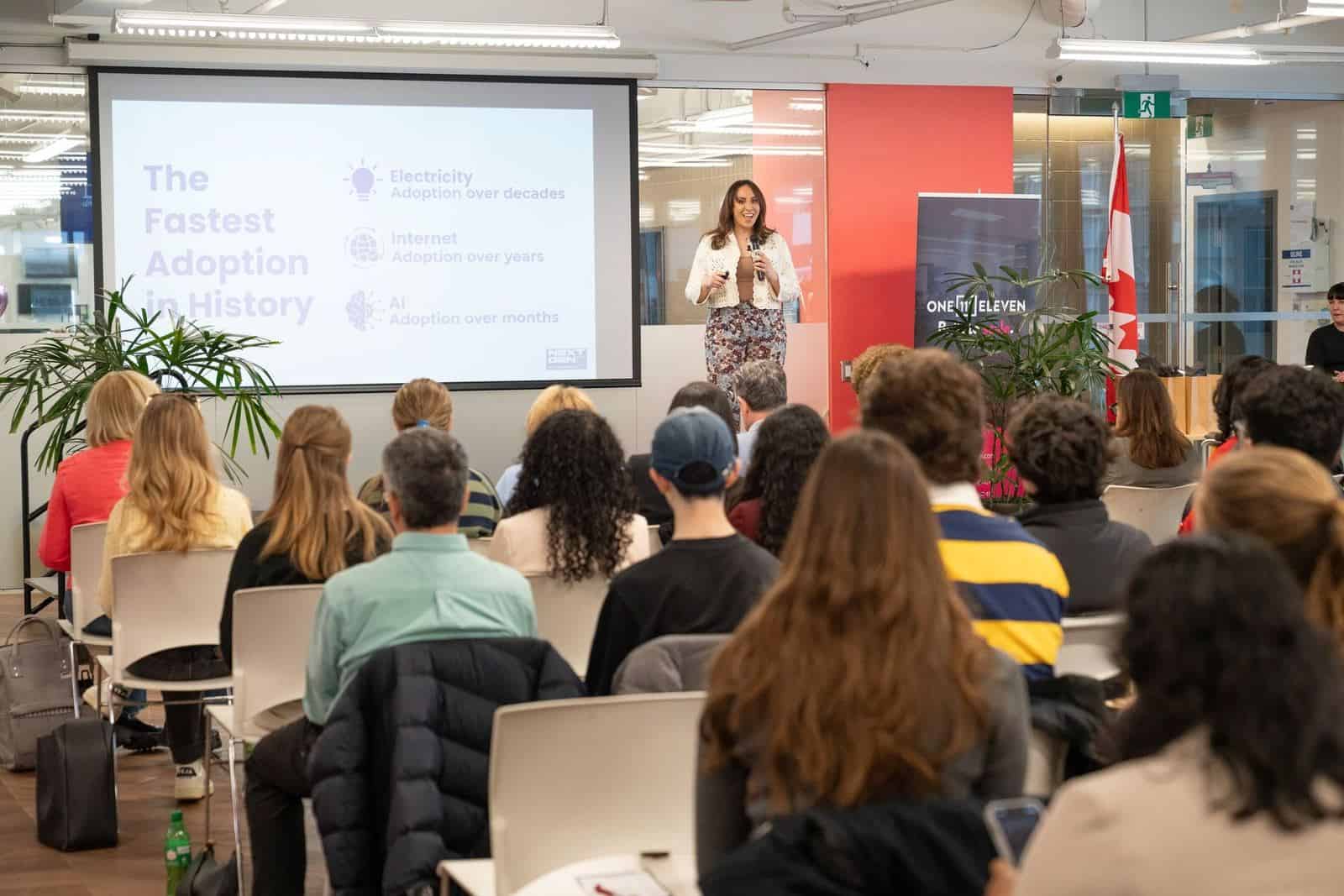
The Next Big Thing is built for executive leadership teams and boards, transformation and operations leaders, and innovation, technology, and digital teams, as well as conferences focused on AI, the future of work, and emerging technology. It is fast-paced, evidence-based, and grounded in real transformation experience rather than vendor hype. Audiences leave able to start with the business problem instead of the tool, to recognize and avoid transformation theatre, to align people, processes, and platforms around a measurable outcome, and to build the workforce capability that turns technology into results. They leave with a way of thinking they can apply to the next technology decision on their desk, which in a field that reinvents itself every eighteen months is more durable than any single tool.
A diagnostic for your next technology investment
Before approving the next pilot or platform, a short set of questions separates investments that will deliver from activity that will not.
- Are we starting with a business problem and a measurable outcome, or with a technology we feel we should adopt?
- Have we redesigned the workflow, decision rights, and metrics around the technology, or only installed it?
- Do the people who will use it have the skills, time, and permission to work in the new way?
- Are we measuring the business result this was funded to produce, or the activity around it?
- Are we prepared to stop what is not moving the number, rather than keep it alive because it was announced?
Bring The Next Big Thing to your event
Suzanne helps leaders cut through the noise around AI and digital transformation and focus time and money on what moves the needle. The keynote is available as a 45-minute keynote, a 90-minute session, or a half- or full-day workshop, virtual or in person, and can be tailored to your industry and audience.
Frequently asked questions
Q: Why do most AI and digital transformation initiatives fail to deliver ROI? A: Three reasons, and they tend to travel together. They start with the technology rather than a business problem. They treat the work as an installation rather than an operating model change. And they measure activity rather than impact. MIT’s 2025 research found 95 percent of enterprise generative AI pilots delivering no measurable impact on profit and loss. What separated the rest was how the technology was integrated into the way people work, not the quality of the underlying models. Q: What is transformation theatre? A: It is the activity that looks like progress, pilots launched, tools deployed, dashboards lit up, while the business result the investment was meant to produce never arrives. It happens when organizations mistake adopting technology for changing how work gets done, and when they count activity instead of measuring outcomes. Q: How do high-performing organizations turn AI into measurable results? A: They start with the business problem rather than the tool, align people, processes, and platforms so the workflow actually changes, build the workforce skills and culture the technology requires, and hold themselves to business impact rather than activity. The technology is the accelerant; redesigning how people work is the engine. Q: Is the problem with AI the technology itself? A: Usually not. The research is consistent that the barriers are organizational rather than technological: integration into workflows, skills, decision rights, and measurement. Organizations that treat AI as a systems-and-people change rather than a tool purchase are the ones that capture value. Q: Who is this keynote for? A: Executive leadership teams and boards, transformation, operations, and strategy leaders, innovation, technology, customer, and digital teams, and conferences focused on AI, the future of work, and emerging technology. It suits audiences that need to convert technology investment into measurable business performance.
About Suzanne Knight
Suzanne Knight, MBA, MA is a keynote speaker and transformation strategist who helps leaders turn complexity into clarity, unlock capacity, and deliver measurable results. She led Digital and Efficiency Transformation at Walmart Canada and has advised more than 80 organizations across 14 countries, spanning Fortune 500 companies, governments, and high-growth teams.
She is the founder and CEO of mBolden, a global management consulting firm, a TEDx speaker, and an instructor at the Schulich School of Business Executive Education. She has been trusted on stage and as an advisor by organizations including Walmart, TD, Manulife, Deloitte, and the governments of Canada and Ontario, and has been featured by Forbes Middle East and ChosunBiz, the largest media agency in Korea.
Her work centres on a single conviction: transformation succeeds or fails through execution, and the quality of the strategy cannot overcome ineffective delivery.
Sources and references
- MIT NANDA initiative. (2025). The GenAI Divide: State of AI in Business 2025. Reported by Fortune. Source ↗
- McKinsey & Company. (2025). What is an operating model, and why does it matter? Source ↗
- Bain & Company. (2024). 88% of business transformations fail to achieve their original ambitions. Source ↗